
 English
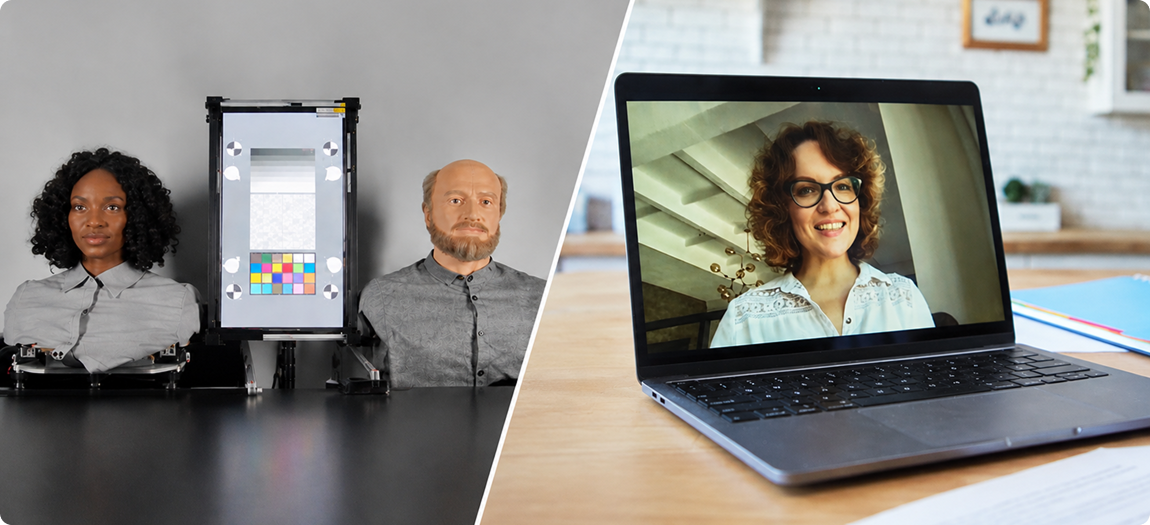
Since DXOMARK introduced its first video call protocol three years ago, video call image quality has improved significantly. Advances in camera hardware, image signal processing (ISP), HDR rendering, and AI-powered image enhancement have driven clear gains in exposure, skin-tone reproduction, and color consistency.
But as technology evolves and user expectations change, a benchmark must evolve with them. This is the thinking behind DXOMARK Video Call V2, a new-generation protocol designed to reflect the technologies, use cases, and image quality expectations shaping video calls today.
By expanding real-world testing scenarios, and streamlining laboratory testing through automation, Video Call V2 provides a more comprehensive assessment of video call image quality.
What are the key evolutions of the DXOMARK Video Call V2 protocol?
Video Call V2 introduces major upgrades across five key areas, from more demanding real-world scenarios to a fully automated testing workflow.
1. More demanding, real-world scenes
Video Call V2 expands the perceptual shooting plan from four to ten natural-scene videos, covering a broader range of everyday video call situations, including Office, Home Office, Family, and Duo scenarios.
The protocol also introduces three dedicated low-light scenes and a wider range of lighting conditions, from SDR to light and strong HDR, across natural, artificial, and mixed lighting environments.
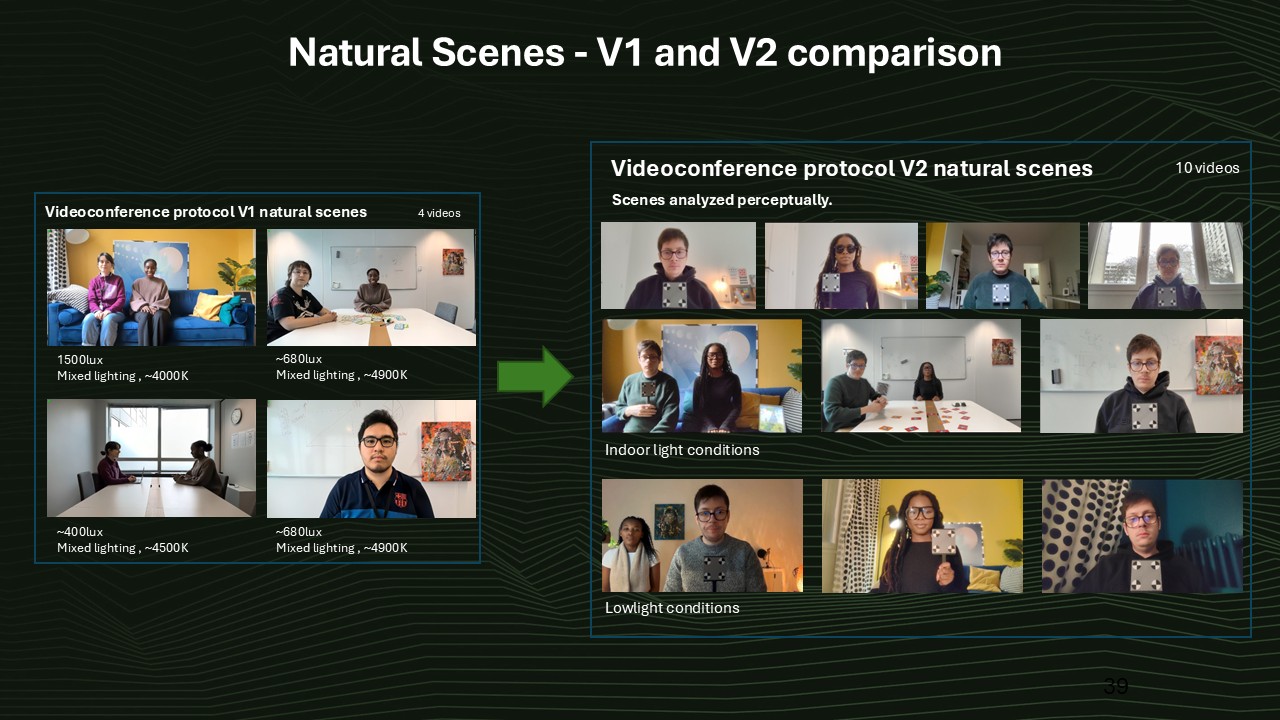
With more varied subject-focused framing and challenging camera scenarios, Video Call V2 evaluates devices under a broader range of conditions. This expanded coverage provides a more comprehensive and demanding assessment of video call image quality, bringing the evaluation closer to the situations users encounter in everyday life.
2. Richer motion scenarios
Video calls are rarely static. Users move closer to or farther from the camera, enter and leave the frame, and change position while speaking. These movements can challenge a device’s ability to maintain consistent image quality.
To address these situations, Video Call V2 introduces new motion patterns designed to replicate actual user behavior. These include low- and high-frequency motion, changes in distance from the camera, movements into and out of the frame, and scenarios that trigger face recognition.
The protocol evaluates how effectively devices track and adapt to these changes, assessing autofocus behavior, exposure adaptation, tracking stability, and motion rendering. By introducing more representative motion scenarios, Video Call V2 provides a deeper understanding of how consistently a device performs during real video calls.
3. State of the art objective metrics
Video Call V2 incorporates state of the art objective metrics and enhancements to existing measurement methods to provide a more detailed assessment of video call image quality.
-
- Face detail preservation: An AI-driven metric designed to evaluate how effectively devices preserve texture and fine details on realistic faces.
- Local Contrast Gain (LCG): A new DXOMARK metric that assesses local tone mapping and HDR contrast preservation.
- Improved color assessment: Support for the ICtCp color space, evaluation in both HDR and SDR conditions, and a preference-based approach that goes beyond pure color fidelity to better reflect perceived image quality.
- Auto-exposure analysis: Automated extraction of key parameters, including convergence speed, overshoot, oscillation intensity, and adaptation during transitions.
Together, these developments provide a more detailed view of image processing behavior and the factors that influence perceived video call quality.
Video Call V2 is therefore more than an expanded testing protocol. It also introduces a new generation of testing capabilities and solutions developed by DXOMARK, designed to deliver deeper insight into device performance.
4. Streamlined laboratory testing
Video Call V2 features an All-in-One Video Call setup that simplifies laboratory testing by measuring multiple aspects of image quality in a single setup. These include face exposure and detail, color accuracy, white balance, contrast, visual noise, frame rate, and how quickly the camera adapts to changes in lighting. With more than ten objective measurements captured in a single shot, this approach helps assess how well a camera delivers clear, natural-looking video calls across different lighting conditions, including HDR.
5. A fully automated testing workflow
Video Call V2 also introduces an end-to-end automated testing workflow, covering image acquisition, lighting changes, measurement, detection, and reporting, with minimal manual intervention.
Automation reduces the need for repetitive manual operations and helps ensure greater consistency across testing sessions. It also makes the solution easier to deploy in different laboratory environments, supporting a more systematic and repeatable approach to video call image quality assessment.
The DXOMARK Video Call V2 score: Assessing the complete user experience
With the Video Call V2 protocol, the evaluation introduces updated attributes and revised weightings to provide a more detailed assessment of video call image quality. This approach combines measurable technical performance with expert visual assessment to better characterize image quality across different conditions.
The image below provides a detailed breakdown of the scoring methodology
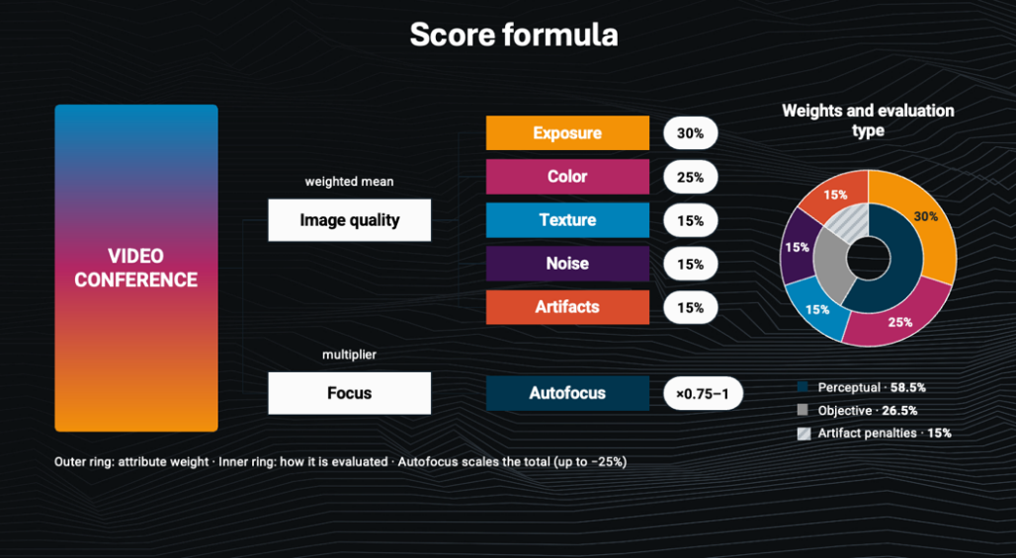
This combination allows the public score to account for both measurable image characteristics and the way those characteristics affect the perceived quality of a video call. By complementing objective measurements with perceptual assessment, the protocol aims to provide a more representative evaluation of everyday performance.
Global ranking and the evolution of each image quality attribute
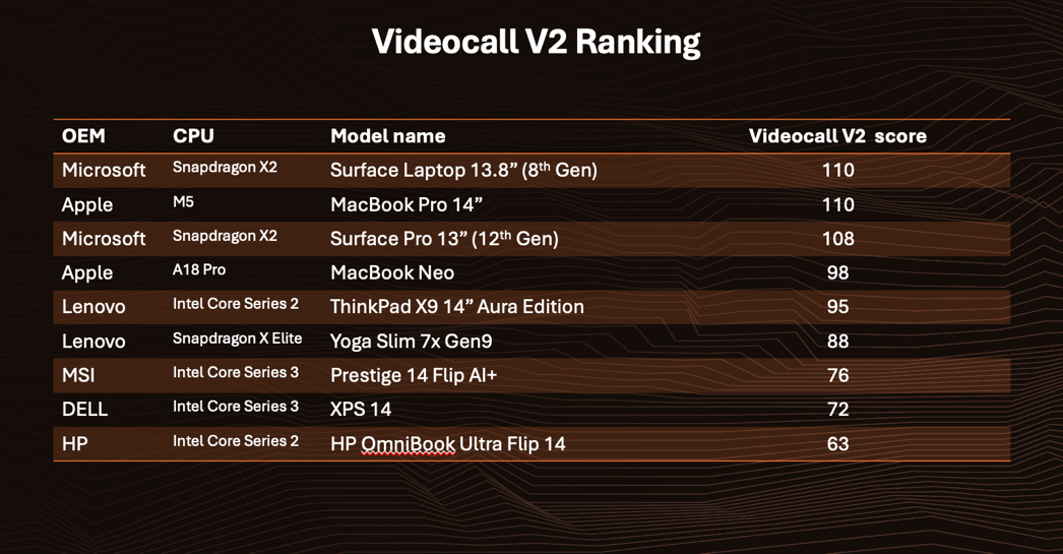
Nine laptops have been evaluated using the new DXOMARK Video Call V2 protocol, providing an initial overview of video call image quality across the current computing ecosystem.
The Microsoft Surface Laptop 13.8-inch (8th Gen) and Apple MacBook Pro 14-inch retain their leading positions from the previous generation of the protocol, demonstrating consistent performance across the evaluation. The Microsoft Surface Pro 13-inch (12th Gen) takes third place, followed by the Apple MacBook Neo in fourth, with performance matching that of much more expensive premium devices.
The overall results reveal substantial differences in video call image quality, with scores ranging from 110 to 63. This spread reflects differences in device performance, as well as the broader measurement coverage introduced by Video Call V2, particularly in perceptual evaluation, and improvements to the laboratory testing setup.
Beyond the global ranking, the updated protocol provides a more detailed assessment of individual image quality attributes. The following sections examine how the protocol evaluates each major attribute and how its expanded testing capabilities provide deeper insight into video call image quality.
Highlights from some of the top-tier devices
Microsoft Surface Laptop 13.8-inch (8th Gen): Solid performance in bright and moderately challenging conditions
The camera delivers generally balanced performance, particularly in bright lighting conditions. Its neutral white balance keeps colors natural and pleasant, while good detail preservation and low noise produce a clean image for standard video conferencing. It also handles moderate HDR scenes well, maintaining a reasonable balance between bright and dark areas.
Performance becomes less consistent in indoor and low-light environments, where noise can become pronounced, especially on moving subjects. Some fine detail is lost, and occasional artifacts, such as ghosting, can affect motion rendering. In very dark conditions, faces may be underexposed, reducing facial detail and overall image quality.
Apple MacBook Pro 14″ (M5, 2025): A well-balanced camera with accurate exposure and controlled noise
The camera delivers strong and consistent performance, particularly in face exposure and dynamic range. Face exposure is generally accurate, while the extended dynamic range helps balance highlights and shadows, producing natural-looking images across a wide range of lighting conditions
Noise is well controlled without excessively compromising texture, and subjects remain in focus in most situations, contributing to a stable video-conferencing experience. However, some white balance and color inaccuracies appear under more complex lighting conditions. Detail can also be limited when the subject is positioned farther from the camera, with shots taken at around 80 cm showing a more noticeable loss of fine detail.
Lenovo Yoga Slim 7x Gen9: Impressive detail and good face exposure
The camera delivers a very high level of detail across the tested lighting conditions, making detail preservation its main strength. Fine textures remain well preserved, from bright environments to more challenging lighting conditions, resulting in a detailed image that is particularly beneficial for video conferencing.
Face exposure is generally good, even in challenging lighting, ensuring that faces remain reasonably visible when illumination is complex. In bright conditions, color rendering is acceptable during static video-conferencing scenarios, contributing to an overall pleasant image.
However, noise is highly visible in indoor and low-light conditions and becomes more pronounced as available light decreases. Exposure and white balance instabilities can also occur, particularly in challenging motion scenarios. In low-light HDR scenes, noticeable clipping can lead to a loss of information in bright areas. Skin tones can also appear inaccurate, affecting the overall naturalness of the image.
Conclusion
With the launch of DXOMARK Video Call V2, we reaffirm our commitment to providing reliable, comprehensive, and relevant assessments of laptop camera performance. By incorporating state-of-the-art objective metrics, expanded testing scenarios, and enhanced laboratory evaluation methods, Video Call V2 brings a more detailed approach to measuring video call image quality. As laptop cameras and image processing technologies continue to evolve, this updated protocol strengthens our ability to assess performance across a wide range of lighting conditions and everyday situations, ensuring that our evaluations provide a clear and consistent view of the strengths and limitations of laptop cameras.